Four ways in. Not four departments.


Most agencies sell you a service line and then quietly subcontract the half they do not do. We sell you a method and staff the whole of it. Whichever entry point below is closest to your problem, the same team runs Clarify → Capture → Craft → Amplify behind it — which is why the argument you approve in week one is still intact in the finished work.

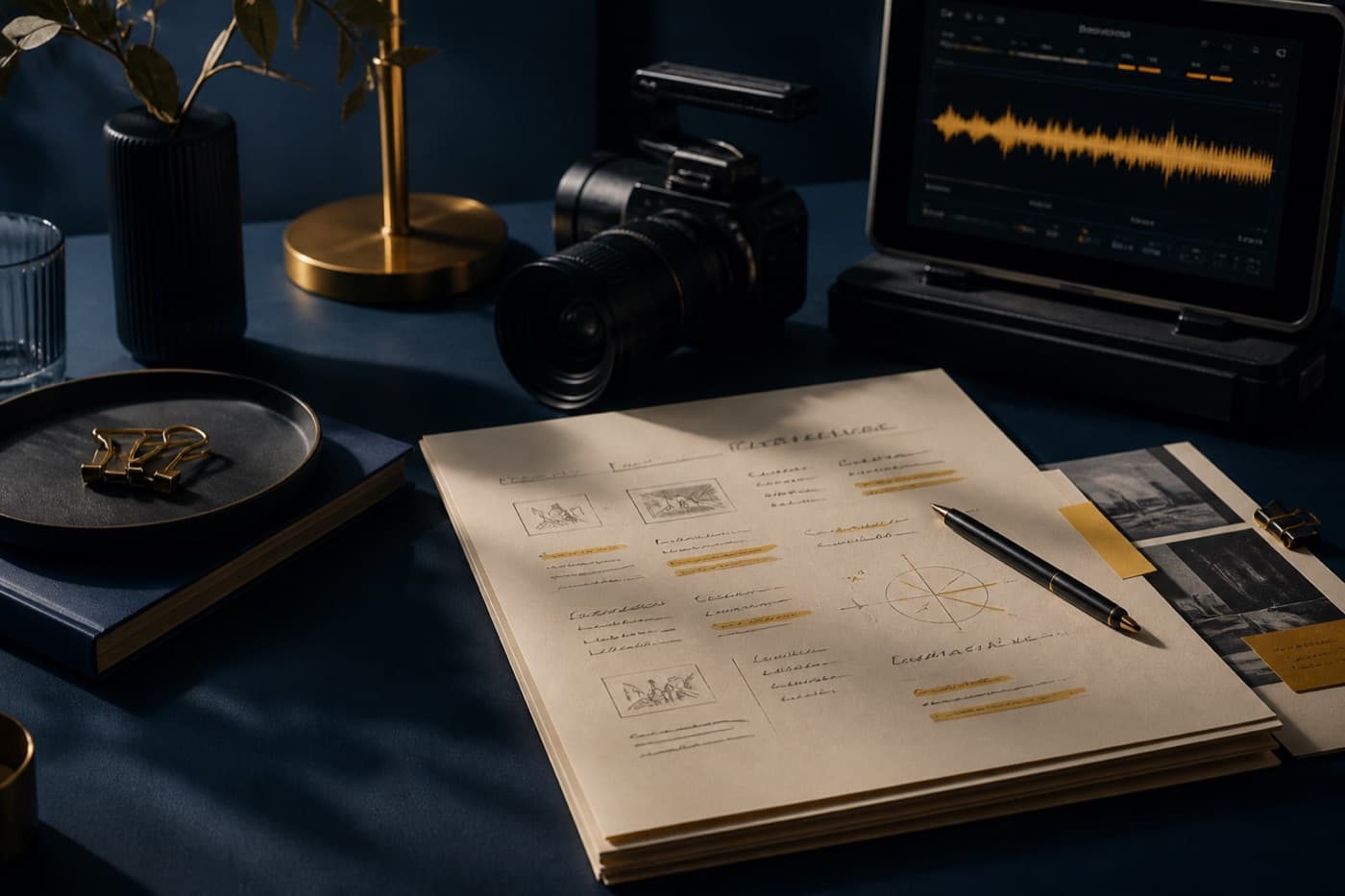
A marked-up brief beside production equipment

Entry points

Start where the pressure is.

Most agencies sell you a service line and then quietly subcontract the half they do not do. We sell you a method and staff the whole of it. Whichever entry point below is closest to your problem, the same team runs Clarify → Capture → Craft → Amplify behind it — which is why the argument you approve in week one is still intact in the finished work.

  1. 01

    Message and positioning

    Before anyone books a studio, we work out what you actually know that your market does not — and whether you are prepared to defend it in front of an analyst. This is Clarify: Decide what you are actually saying, and to whom, before anything is produced.

    The output is a written argument, not a mood board. If you already have a positioning deck, we will pressure-test it rather than restart it.

    You get

    • A written positioning and message architecture
    • Named audience segments and the questions each one is actually asking
    • The editorial argument every asset will ladder up to
    Best for
    your team can describe what you do but not why it matters more than the alternative, or every asset you produce says something slightly different.
    What RMG makes
    A written positioning and message architecture, Named audience segments and the questions each one is actually asking, The editorial argument every asset will ladder up to
    Next decision
    Decide whether the message needs to be clarified or pressure-tested before production.
  2. 02

    Video and podcast production

    Films, interview series and podcast episodes, produced by the people who wrote the argument they are meant to carry. This spans Capture and Craft — the same team is in the room and in the edit.

    Edit and produce the captured material into work that carries your name credibly.

    You get

    • Films, podcast episodes and edited interview series
    • Written analysis, editorial features and session recaps
    • Short-form cuts derived from the same source, not shot separately
    Best for
    you have production budget and a subject worth filming, but the last one came back looking right and saying nothing.
    What RMG makes
    Films, podcast episodes and edited interview series, Written analysis, editorial features and session recaps, Short-form cuts derived from the same source, not shot separately
    Next decision
    Decide which capture and craft outputs should carry the argument.
  3. 03

    Event and live capture

    Keynotes, panels, executive interviews and customer conversations, captured with the editorial plan already written. This is Capture, and it is the stage this category systematically underestimates.

    Capture is where most engagements quietly break, because it is where most agencies hand a brief to a crew they do not employ. We do not hand it off. The people who wrote the argument in Clarify are in the room for the keynote, the executive interview, the panel, the customer conversation, listening for the moment the argument comes true out loud. That is a different job than pointing a camera, and it is why the footage comes back usable.

    You get

    • Live event, executive interview and panel capture
    • Editorially directed interviews, not recorded Q and A
    • Source material logged against the argument it proves
    Best for
    you have a date on the calendar. Everything that makes event footage reusable has to be decided before the room fills, not discovered in the edit.
    What RMG makes
    Live event, executive interview and panel capture, Editorially directed interviews, not recorded Q and A, Source material logged against the argument it proves
    Next decision
    Decide what must be captured in the room and what it needs to become afterward.

  4. 04

    Authority content, ongoing

    A standing programme rather than a project: a recurring cycle of Clarify → Capture → Craft → Amplify, so your point of view compounds instead of resetting every quarter. Put the work where the audience already is, then keep improving it on evidence.

    What we learn in Amplify rewrites the next Clarify. That loop is the actual product.

    You get

    • Channel sequencing and a distribution calendar
    • Executive and analyst enablement for the people whose names are on the work
    • Performance read against the editorial argument, on a twelve-month horizon
    Best for
    you are producing steadily and it is not accumulating into anything — no compounding audience, no recognisable position, no reason for an analyst to remember you.
    What RMG makes
    Channel sequencing and a distribution calendar, Executive and analyst enablement for the people whose names are on the work, Performance read against the editorial argument, on a twelve-month horizon
    Next decision
    Decide whether a recurring programme is the right shape for the point of view you need to build.

The sequence underneath

The Captivate Framework

Whichever service line starts the conversation, the actual work still follows the same order so the argument does not degrade when the production starts.

01

Clarify

Clarify is research and argument. We work out what you know that your market does not, who specifically needs to hear it, and what claim you are prepared to defend in front of an analyst. The output is a written position, not a mood board. Everything downstream is built to serve it, and we do not move on until you can say the argument back in one sentence.

02

Capture

Capture is where most engagements quietly break, because it is where most agencies hand a brief to a crew they do not employ. We do not hand it off. The people who wrote the argument in Clarify are in the room for the keynote, the executive interview, the panel, the customer conversation, listening for the moment the argument comes true out loud. That is a different job than pointing a camera, and it is why the footage comes back usable.

03

Craft

Craft is editorial and production in the same room. Films, podcast episodes, written analysis, session recaps and the short-form cuts that travel are all built from the same captured material by people who were present when it was captured. Because nothing is being reverse-engineered from a stranger’s footage, the argument survives the edit intact.

04

Amplify

Amplify is launch, distribution and the twelve months after. The work is sequenced across the channels your buyers actually use, the executives whose names are on it are equipped to carry it, and performance is read against the argument rather than against vanity metrics. What we learn here rewrites the next Clarify. The framework is a loop, not a line.

Repurposing with intent

One capture, many finished pieces — but only if you plan it that way.

You cannot repurpose what you did not capture. The reason most event and interview footage produces one asset instead of a dozen is not editing budget; it is that nobody decided in advance what argument each moment was supposed to prove. Because our editorial team runs Capture themselves, the derivative work is designed at the point of capture rather than salvaged afterwards.

The handoff from a strategist’s brief to a separate production crew, where narrative fidelity is lost and nobody is accountable for the loss.

Live capture equipment arranged for a production
Capture / 02Editorial planning at capture time is what makes later outputs possible.

Next step

Not sure which door you are standing at?

Most people are not, and it does not matter much. Tell us the problem in plain language and we will tell you where in the Captivate Framework it actually sits — including when the honest answer is that you do not need us yet.